
Gyula Grosics was a Hungarian goalkeeper considered one of the greatest in European football history, a member of the legendary Hungarian national team known as the 'Golden Team' (Aranycsapat) of the 1950s. He earned the nickname 'Black Panther' for his elegant posture and quick reflexes, and was also one of the first goalkeepers to regularly play outside the penalty area, a role that would today be described as 'libero'. Grosics played for Budapest Honved from the late 1940s, a club that brought together the core of the Hungarian national team at that time, including Ferenc Puskas and Sandor Kocsis. After the 1956 Hungarian Revolution, unlike several of his teammates who left the country, Grosics remained in Hungary and continued his career at Tatabanyai Banyasz. For the Hungarian national team, he was instrumental in winning Olympic gold in Helsinki in 1952, and in the campaign that took Hungary to the 1954 World Cup final in Switzerland, which was lost to West Germany in what was called the 'Miracle of Bern'. His performance in that tournament is remembered as one of the greatest individual displays by a goalkeeper in World Cup history. After retiring from football, Grosics remained connected to Hungarian football and is revered to this day as a symbol of one of the greatest national teams never to win the World Cup.
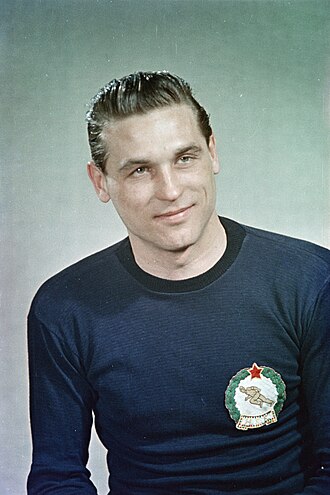
Gyula Grosics
Gyula Grosics was a Hungarian goalkeeper considered one of the greatest in European football history, a member of the legendary Hungarian national team known as the 'Golden Team' (Aranycsapat) of the 1950s. He earned the nickname 'Black Panther' for his elegant posture and quick reflexes, and was also one of the first goalkeepers to regularly play outside the penalty area, a role that would today be described as 'libero'. Grosics played for Budapest Honved from the late 1940s, a club that brought together the core of the Hungarian national team at that time, including Ferenc Puskas and Sandor Kocsis. After the 1956 Hungarian Revolution, unlike several of his teammates who left the country, Grosics remained in Hungary and continued his career at Tatabanyai Banyasz. For the Hungarian national team, he was instrumental in winning Olympic gold in Helsinki in 1952, and in the campaign that took Hungary to the 1954 World Cup final in Switzerland, which was lost to West Germany in what was called the 'Miracle of Bern'. His performance in that tournament is remembered as one of the greatest individual displays by a goalkeeper in World Cup history. After retiring from football, Grosics remained connected to Hungarian football and is revered to this day as a symbol of one of the greatest national teams never to win the World Cup.